Casestudy

Bounding Box Annotation for Architectural Floorplans: How We Delivered 100% On Time

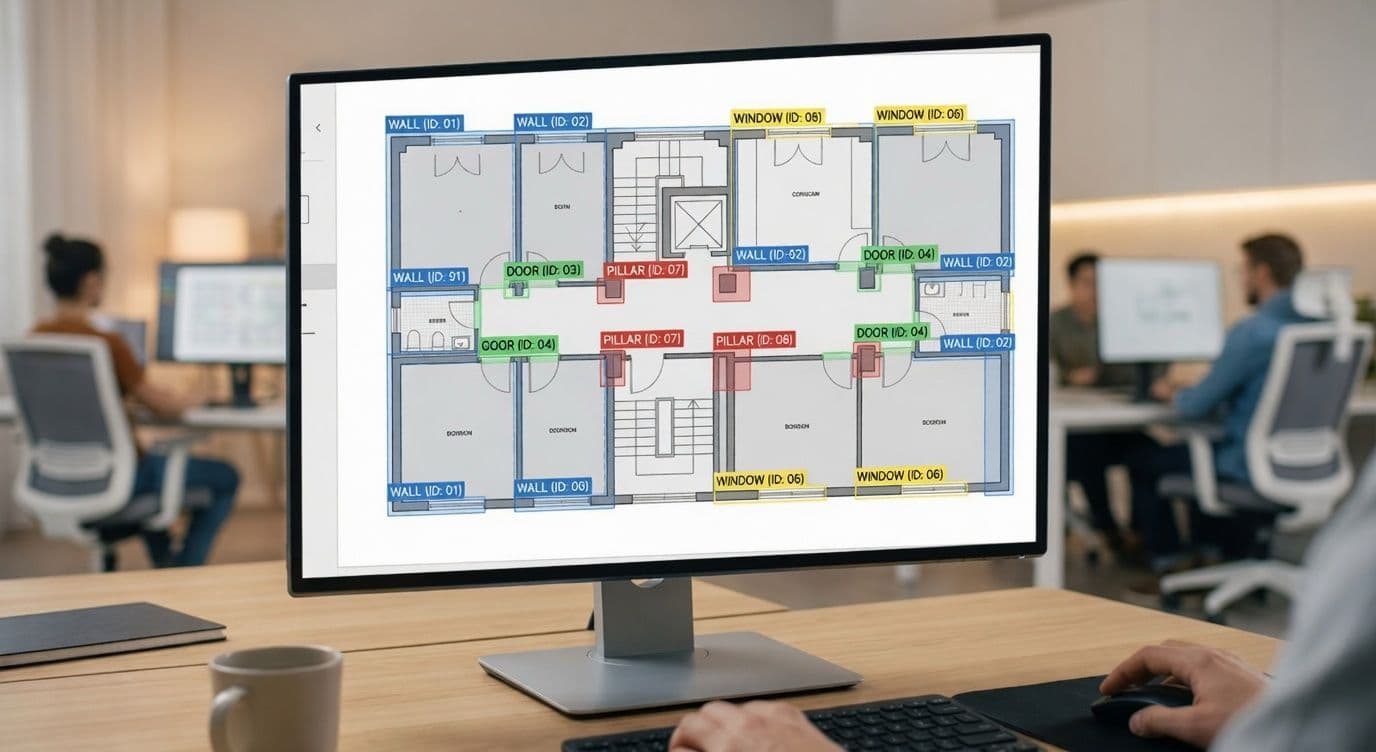
Logictive Solutions completed a full bounding box annotation project for Deeparts, a PropTech company building an AI model that reads architectural floor plans. We labeled 500+ Floorplans, marked four structural elements in each one, and delivered a clean computer vision training dataset that the client's development team could plug straight into their AI model.
Target Industries:
Architecture
Bounding Box

Outcome Framework

Services We Provided

01
Project Management
02
Annotation

Project Overview

This project focused on training an AI model for advanced floorplan labeling. The main targets were windows, doors, pillars, and walls, all with the aim of detecting, isolating, and labeling them with the greatest of accuracy throughout the entire dataset. We created an agile and standardized labeling workflow using our main environment, CVAT (Computer Vision Annotation Tool). We also used a collaborative group of annotators, who collaborated with specialized QA reviewers to ensure that outputs were accurate and conformed to project guidelines.

WhatsApp Image 2026-05-28 at 15.13.31.jpeg

Approach and Process: Four Steps

The team project work approach involved four main steps

01

Uploading Task

The Quality Assurance (QA) Lead owns the CVAT environment. They upload raw layouts, organize batches, and update daily production progress reports.
02

Annotation

The core annotation team takes over. Regular members execute micro-precision bounding boxes according to the layout schedules and live progress tracking.
03

QA Check

High standards are embedded, not added later. The QA specialist pauses production tasks to review completed work inside CVAT, delivering real-time feedback and correcting anomalies immediately.
04

Uploading Outcome

Validated data is pushed straight to the client’s database. The QA Lead cross-checks daily progress, calculates remaining files against completed assets, and generates a structured velocity report.

Problems Faced at the Beginning

The Barriers We Experienced at the Start

Tools Lagging:

High-resolution floor plans combined with thousands of bounding boxes caused severe tool latency due to hardware limitations and bandwidth constraints.

Lack of Clarity

As layout complexity grew, we discovered unique architectural styles and edge cases that required instant domain judgment.

Missing Initial Deadlines

Object density varies wildly per blueprint. Without an initial baseline, early estimations were overly optimistic, leading to missed timelines.

Techniques for Managing Challenges

Engineering the Solution:

Structured Q&A Logs

We introduced a live, shared Q&A document to log unique floorplan variations for instant client clarification. This eliminated guesswork and ensured 100% team consistency.

Data Driven Planning

To fix our timelines, we analyzed completed batches to calculate exact "annotation-to-file ratios." This transformed manual guesswork into predictable project milestones.

Infrastructure Upgrades

We upgrade the local team's hardware and enhance the internet bandwidth, eliminating CVAT software lag to maximize daily output.

Project Outcomes and Results

We didn't just deliver a dataset. We delivered something a development team could plug straight into their neural network and say, "We trust this."

500+ Floorplans Labeled

Successfully annotated with complete spatial coverage and zero margin for error.

100% On-Time Delivery

Post-mitigation, our data-backed planning allowed us to hit every single final deadline without a single delay.

Key Insights on Communication and Training

Open Communication

01
Crucial for managing complex architectural variations and aligning annotators on strict dataset definitions.

Proper Training

02
Specialized onboarding prepares the team to recognize and handle structural anomalies instantly.

Future Improvements and Operational Efficiency

01

Upgraded device and Bandwidth

Continuous scaling of the IT infrastructure is necessary to prevent tool lagging in CVAT as annotation counts increase.
02

Task Size and Device Matching

Proactively routing heavy, complex blueprint files to workstations with better performance to reduce lagging and boost throughput.
03

Break Frames for High-Annotation Tasks

Segmenting massive layout tasks into smaller frames so multiple people can collaborate simultaneously without system strain.
04

Include Extra Time on Deadline

Factoring a structured time buffer into project deadlines to safely absorb the unpredictable nature of architectural datasets.